OpenAI Dots and the Economic Paradox of Personal Agents
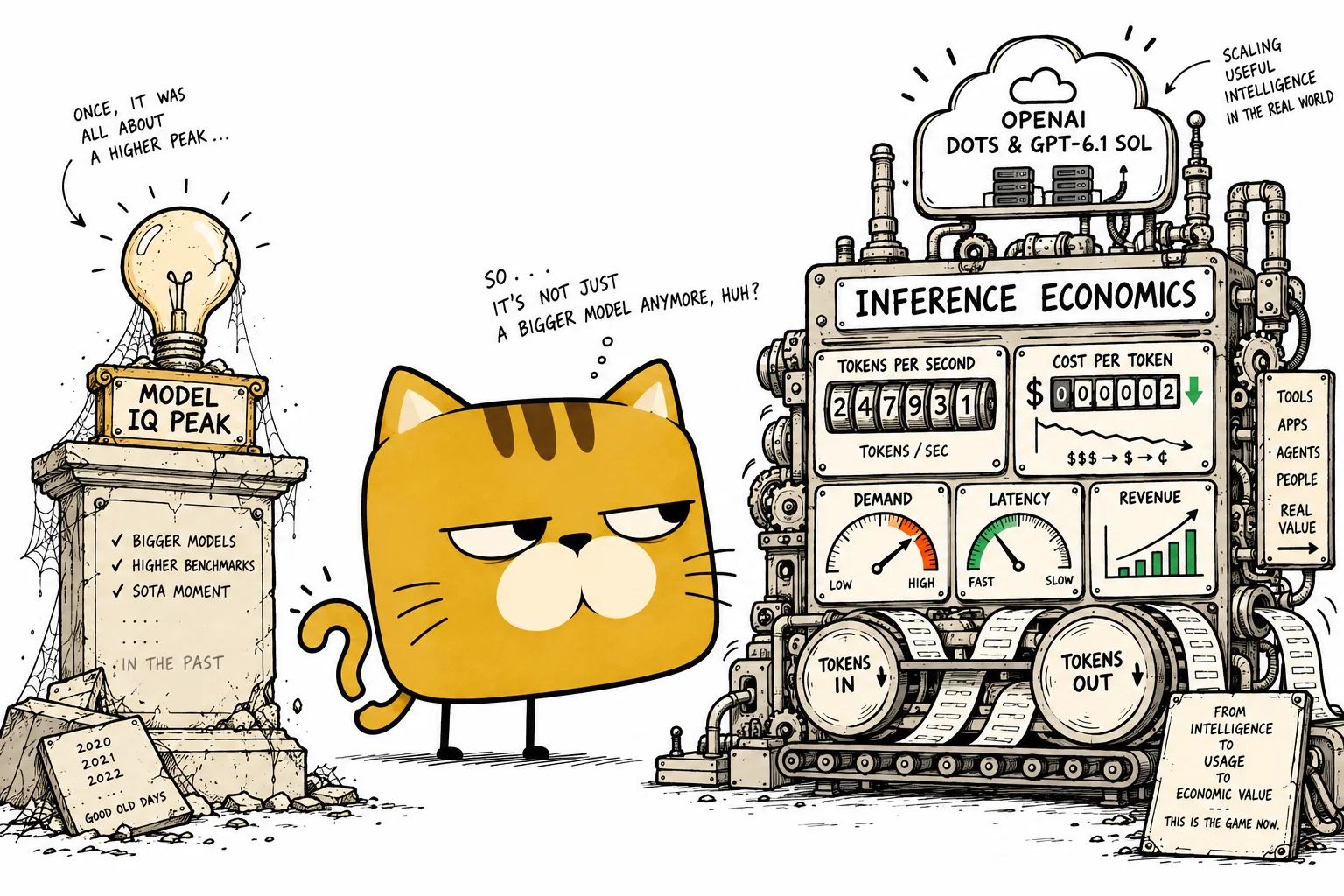
At OpenAI DevDay, the tech industry naturally fixated on Dots, OpenAI’s newly unveiled persistent personal agent. Equipped with a dedicated cloud computer, multi-session memory, and the ability to execute long-running asynchronous tasks while you sleep, Dots represents the clearest consumer manifestation of an always-on digital worker.
Yet the real strategic signal was not the user interface of Dots. It was the underlying engine released alongside it: GPT-6.1 Sol.
OpenAI positioned GPT-6.1 Sol with clinical precision: near-frontier performance in complex software engineering, computer use (GUI navigation), and multi-step agentic workflows, compressed down to $2.00 per million input tokens and $10.00 per million output tokens.
The simultaneous launch of Dots and GPT-6.1 Sol marks a watershed inflection point for the industry. The competition for personal AI agents is no longer a vanity race for peak benchmark intelligence. It has transformed into an existential battle over the baseline economics of inference.
The economic paradox of persistent agents: From discrete queries to continuous daemons
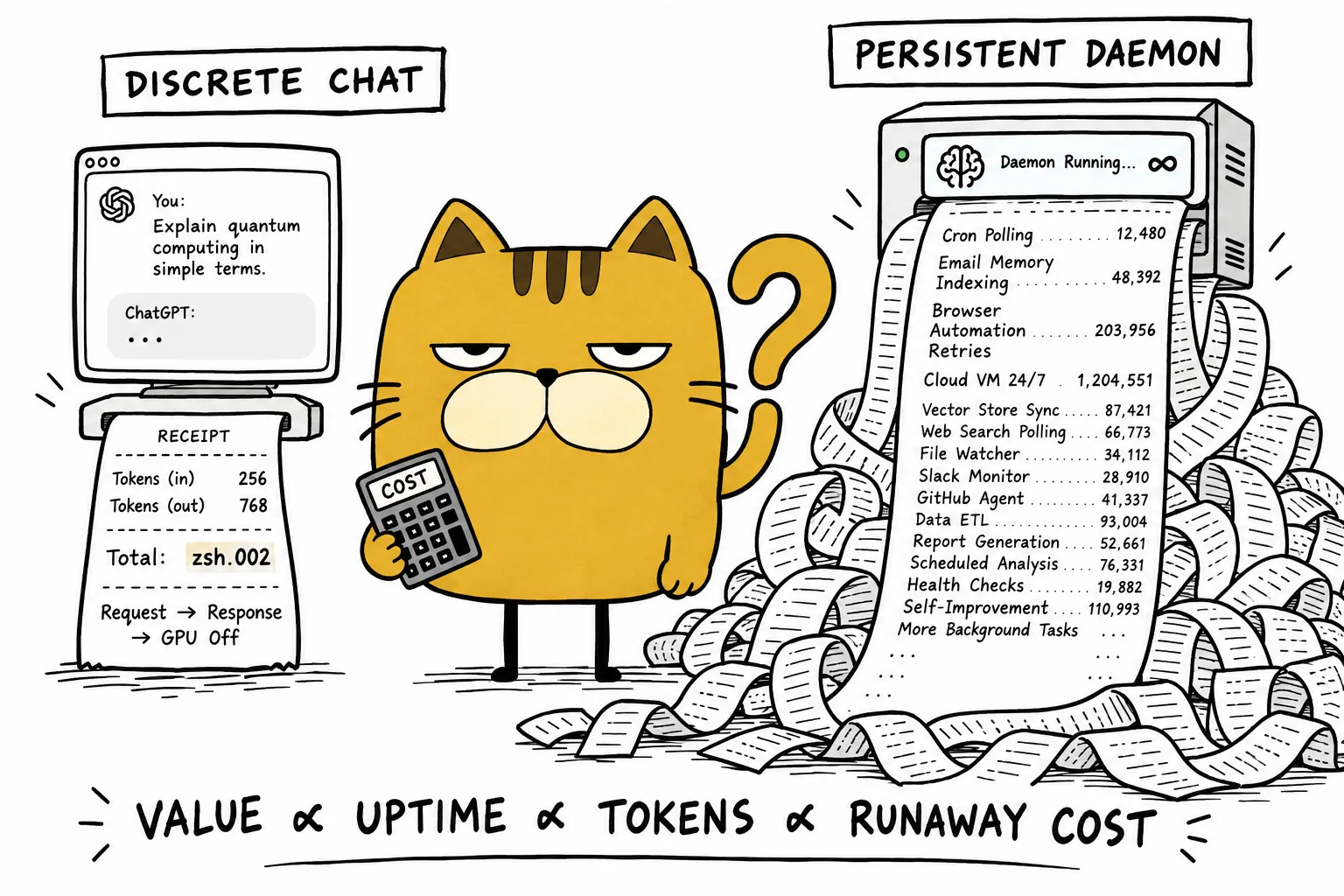
During the chatbot era (2023–2025), commercial software economics relied on a discrete request-response paradigm. A user submitted a prompt, a cluster evaluated the transformer layers, returned a text stream, and severed the GPU connection. Even heavy power users consumed compute intermittently. Under that usage pattern, a flat $20 monthly subscription comfortably maintained positive unit economics.
A persistent personal agent breaks that financial architecture entirely.
A functional personal agent is not a chatbot; it is a continuous background daemon:
- Continuous state and knowledge maintenance: It continuously indexes long-term memory, maintains personal knowledge graphs, and retrieves context spanning months or years of communications.
- Event-driven proactive execution: Rather than waiting for human input, it actively monitors email inboxes, messaging channels, calendar events, and code repository commits in the background.
- Environment overhead and multi-step rollouts: It occupies a dedicated cloud sandbox (a persistent virtual machine or microVM), driving headless browsers, executing terminal commands, and cycling through iterative Plan-Act-Observe-Reflect loops as explored in our study of stateful agent architectures.
This operational reality introduces the fundamental commercial paradox of personal agents:
Product Value ∝ Runtime Uptime ∝ Reasoning Steps & Context Bloat ∝ Inference & Cloud CapExThe more reliable and indispensable an agent becomes, the more compute and infrastructure resources it consumes. In traditional SaaS, margins expand as user engagement deepens; in persistent AI agents, deep user engagement threatens to invert gross margins.
Once foundation models cross the usability threshold for daily knowledge work, evaluation shifts from synthetic benchmarks to three ruthless operational questions:
- Persistent endurance: How many hours per day can an agent run on behalf of a user at an economically sustainable marginal cost?
- Execution and system privilege: Can the agent reliably cross local operating systems, authentication boundaries, and proprietary data silos to complete tasks?
- The cost carrier: Who pays for continuous, multi-million-token reasoning loops, cloud sandboxes, and headless browser clusters?
Facing this economic equation, different technology giants have arrived at wildly conflicting commercial answers.
The United States: AI-native cost ceilings versus platform cross-subsidization
The battle across the US market has cleaved into two distinct structural camps, with operating system gatekeepers holding the reserve line.
1. The AI-Native Pure-Plays (OpenAI, Anthropic, xAI)
OpenAI (Dots, ChatGPT Work, Codex), Anthropic (Claude Code, Claude Cowork), and xAI (Grok Bot) lead industry product definition. Anthropic’s engineering disclosures emphasize that user sessions are transitioning rapidly from short bursts to multi-hour background workflows. Similarly, xAI provisions a persistent cloud computer for every active Grok Bot user — the same cloud-hosted agent pattern I examined with Meta Muse and Grok Bot.
Yet all three pure-play AI labs face the same structural vulnerability: intelligence is their primary commercial product.
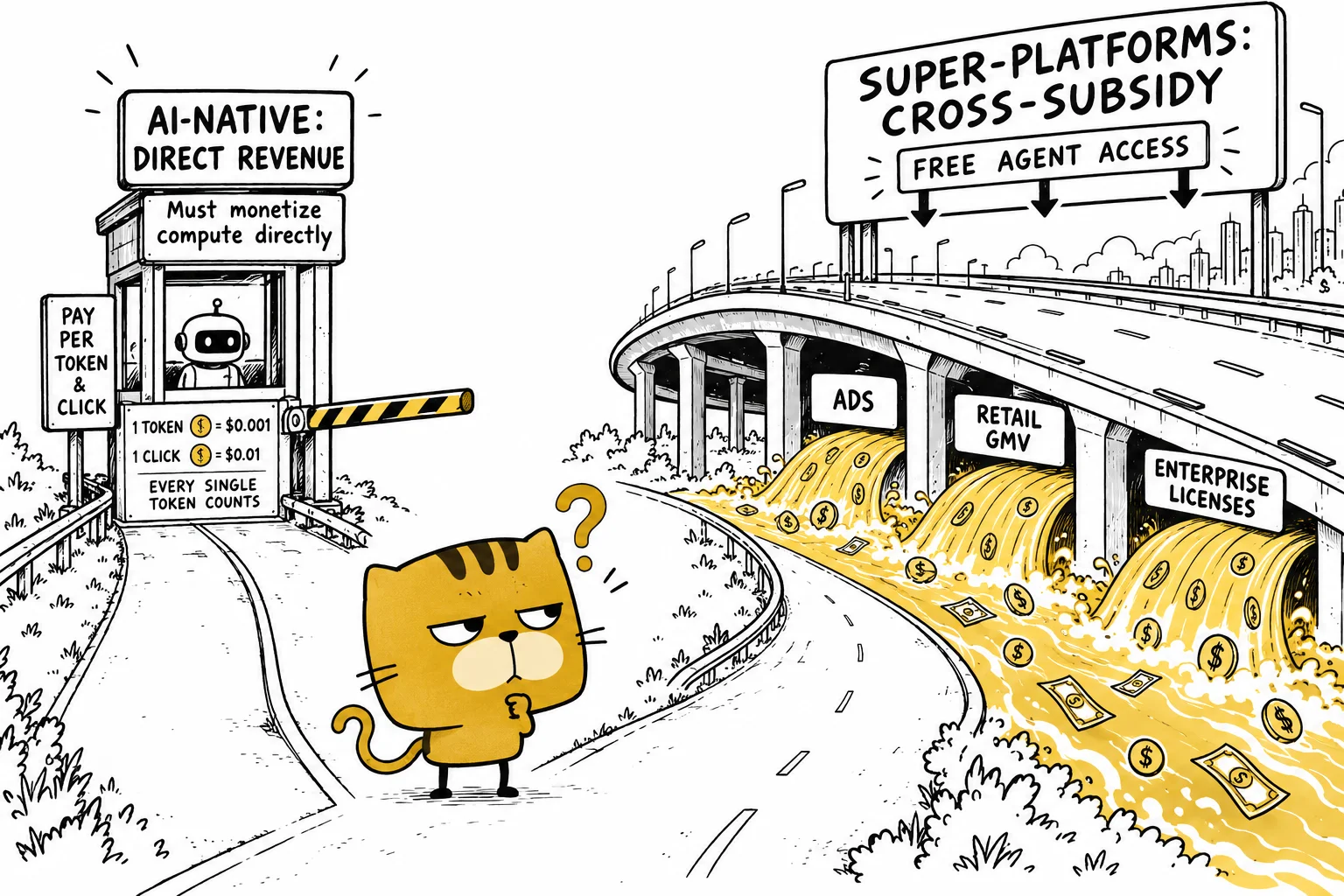
Every autonomous browser click, every terminal error retry, and every multi-step planning cycle must be directly monetized through subscription fees, token-metered billing, or enterprise seat licenses. In a business model where every token must clear a profit margin, offering an always-on, high-context agent daemon to hundreds of millions of consumers for free—or even for a flat $20 per month—creates immense financial strain.
2. The Super-Platform Incumbents (The Cross-Subsidizers)
Established platform giants enjoy a decisive structural advantage: they can treat personal agents as an ecosystem distribution moat, using massive legacy cash flows to cross-subsidize inference and infrastructure costs:
- Meta (The Free Commons & Ad Monetization): Mark Zuckerberg’s strategy targets a consumer base of billions. Meta AI remains completely free, while Meta Muse embeds into WhatsApp, Instagram, and Ray-Ban smart glasses. Meta does not need to extract a $20 monthly subscription from users. If Muse solidifies Meta’s position as the primary conversational layer of daily life, its inference bills are easily recovered through high-intent behavioral graphs, commercial recommendation engines, and business messaging fees. To Meta, the agent can operate as a strategic loss leader.
- Google (Full-Stack Hardware & Traffic Defense): With custom TPU silicon, Google Cloud datacenters, the Gemini model family, and front-door digital distribution across Android, Chrome, and Workspace, Google exercises unmatched full-stack cost control. Lightweight routines run locally on-device or through small models, while heavy multi-modal reasoning runs in cloud clusters. Google’s objective is not selling standalone agent licenses, but fiercely defending its primary Search query gateway.
- Microsoft (Enterprise Productivity Absorption): With Autopilot, Microsoft has embedded persistent agentic behavior into Windows 11, Microsoft 365, and Teams. Microsoft does not need to convince users to adopt new interfaces or add payment methods; the cost of agent inference is invisibly packaged into existing corporate enterprise licensing agreements.
- Amazon (Commerce Fulfillment & Home Orchestration): By folding Alexa+ directly into Amazon Prime, Amazon targets real-world transaction fulfillment rather than coding benchmarks. An agent that orchestrates retail shopping, reorders consumables, books local services, and manages smart home devices directly drives retail Gross Merchandise Value (GMV) and AWS cloud consumption.
3. The Operating System Gatekeeper (Apple)
Apple commands the ultimate distribution point: physical hardware endpoints. Through Siri and Apple Intelligence, Apple possesses on-screen awareness and native execution through App Intents. While its current form remains largely reactive, introducing OS-level background task queues eliminates the need for expensive synthetic cloud sandboxes. As we examined in our analysis of Mac virtualization for AI coding agents, hosting cloud-based macOS environments carries heavy licensing and hardware premiums; Apple bypasses that entirely because the user’s local iPhone or Mac is already the execution environment. For the model partnerships, App Intents interfaces and research behind that position, see Apple’s AI strategy from request to app action.
China: Super-App action pipelines and ubiquitous hardware ecosystems
In the Chinese market, the personal agent competition has bypassed standalone web interfaces, centering instead on transactional fulfillment and multi-device hardware integration.
1. The Super-App Action Pipelines
- Alibaba (Closed-Loop Commercial Execution): The evolution of mobile Qwen marks the transition from “AI that answers” to “AI that acts.” By connecting natively into Taobao, Ele.me, Alipay, Amap, and Fliggy, an agent prompt can directly negotiate product selection, price verification, payment authorization, and physical delivery across Alibaba’s commercial network.
- Tencent (The Social Graph & Mini-Program Matrix): WeChat concentrates over a billion users, a decentralized ecosystem of millions of Mini-Programs, digital identity, and WeChat Pay. Tencent’s agent strategy focuses on compressing fragmented multi-app service journeys into a single chat thread without ever routing users outside WeChat.
- ByteDance (The Autonomous Content Factory): Combining the Doubao consumer assistant, the Seed model matrix, and the TRAE development environment, ByteDance operates an end-to-end automated content assembly line—from social trend scraping and code synthesis to generative video rendering and multi-channel advertising distribution.
2. The Device & Hardware Ecosystems (Huawei & Xiaomi)
Huawei and Xiaomi leverage their unified operating systems (HarmonyOS and HyperOS) to link the “Smartphone – Smart EV – Smart Home” trinity. By running across local hardware, their agents possess privileged access that cloud-only agents cannot replicate: direct screen capture, low-power sensor networks, local camera feeds, and automotive control systems, bridging digital tasks and physical environments.
The distribution dilemma of isolated players
Contrasting these integrated ecosystems against standalone players highlights the severe distribution bottleneck facing isolated AI vendors:
- Mistral (Europe): Mistral launched Vibe, an agentic environment featuring cross-application execution, programming assistance, and support for over a hundred integrated tools. While technically sophisticated, Mistral lacks a consumer super-app front door, an operating system platform, or a native device fleet, leaving it exposed to high customer acquisition costs and platform toll gates.
- Samsung: Samsung’s revamped Bixby acts as a conversational agent across hundreds of millions of mobile displays, smart TVs, and home appliances. However, because its core frontier intelligence and third-party internet services depend heavily on external partnerships, Samsung lacks end-to-end full-stack control.
This landscape underscores the four foundational pillars required to sustain a mature personal agent:
Agent Moat = Frontier Foundation Model + Long-Term Memory / Private Context + End-to-End Fulfillment Permissions + Native High-Frequency Entry PointMissing any one of these pillars degrades an agent into an expensive novelty or a commoditized plugin.
The endgame: The battle for the First Layer
The three major global camps are converging on a single strategic objective: capturing the First Layer of human-computer interaction.
| Camp | Representative Players | Primary Strategic Moat | Commercial Objective & Vulnerabilities |
|---|---|---|---|
| AI-Native Pure-Plays | OpenAI, Anthropic, xAI | Unrivaled model velocity, zero legacy software debt, industry standard-setting | Must charge directly for compute and intelligence; vulnerable to commoditization by free ecosystem alternatives |
| Super-Platform Incumbents | Google, Meta, Microsoft, Amazon, Alibaba, Tencent, ByteDance | Massive core cash flows (ads, retail, cloud, enterprise), self-sufficient compute, cross-subsidization | Securing the next generation of user traffic and operating layers; willing to distribute agents at zero marginal consumer cost |
| OS & Hardware Gatekeepers | Apple, Huawei, Xiaomi, Samsung | Native system-level permissions, hardware-software integration, multi-device physical presence | Model iteration may lag specialized frontier labs, but possesses irreplaceable device-level execution authority |
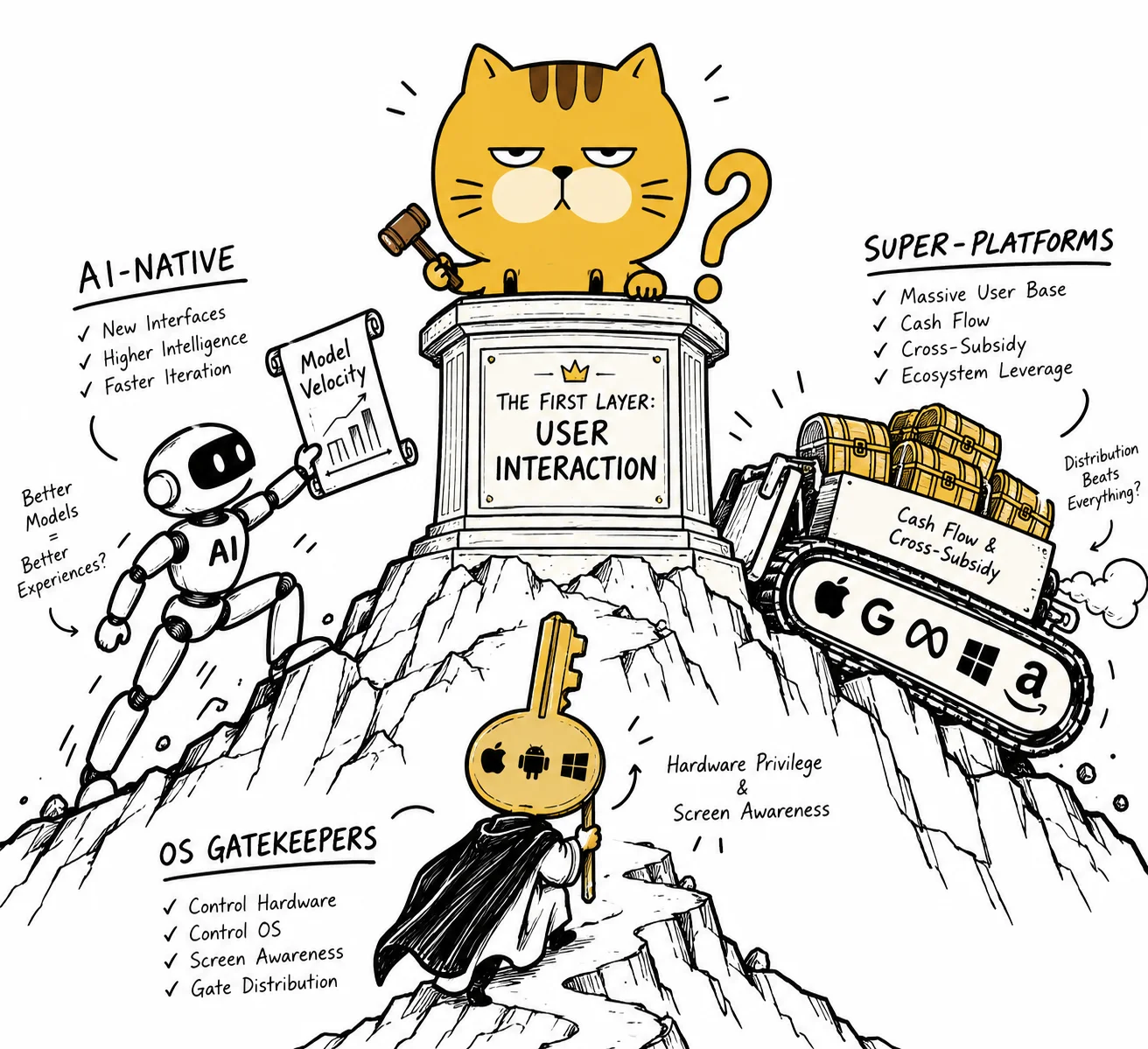
In the personal computer era, the First Layer was Windows and the desktop web browser. In the mobile internet era, the First Layer was iOS, Android, search bars, and super-apps.
In the unfolding agent era, the First Layer is the always-on personal agent that executes tasks autonomously on behalf of the user.
The winning formula is becoming clear:
“Sufficient capability, ultra-cheap inference, and an entrenched distribution channel—pushed to zero marginal consumer price through ecosystem cross-subsidization.”
OpenAI’s unveiling of Dots alongside GPT-6.1 Sol is not the conclusion of the agent race. It is the flare signaling that the commercial war has entered deep water. As tech conglomerates with billions of daily active users, full-stack datacenters, proprietary hardware fleets, and massive cash reserves deploy their ecosystems, the true global war for the personal agent has only just begun.
Since publishing this, I have written a companion piece on the capital cycle forcing that pace: Why OpenAI Is Sprinting: Inside the AI Bubble’s Capex Trap.