Why OpenAI Is Sprinting: Inside the AI Bubble's Capex Trap
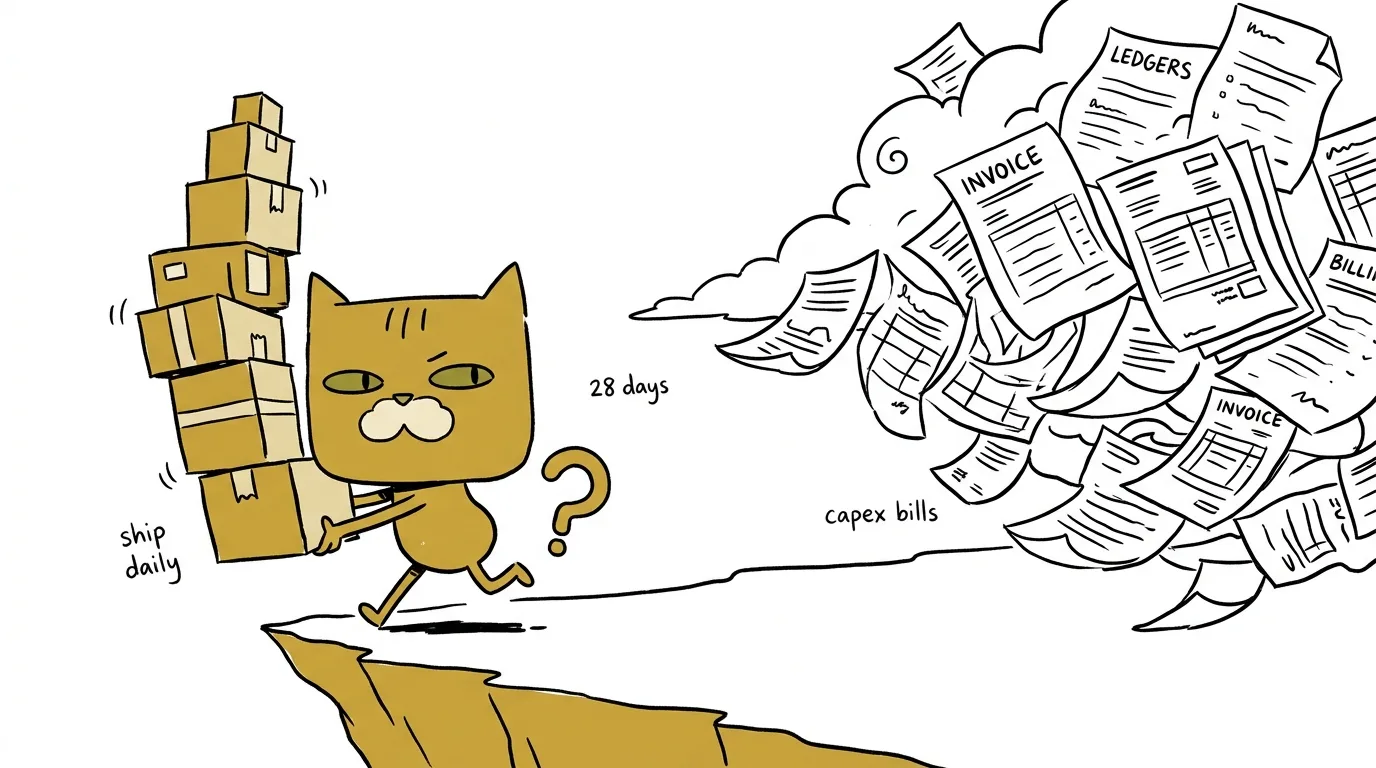
On October 4, the OpenAI executive in charge of Codex and ChatGPT Work issued his team a near-impossible public wager: ship one improvement that most Codex and Work users can actually feel, every day for the next 28 days — or reset every user’s usage quota, free of charge, across the board. Ordinary software companies do not punish missed targets by giving away their scarcest resource. My read is that this sprint is not bravado but cold, rational defense: OpenAI is converting paper valuation into product stickiness while its capital window is still open, with GPT-6.1 Sol and persistent agents as the engine. That is what makes this the AI bubble’s most dangerous phase — genuine, world-changing technology sitting on top of fragile cash flows.
A note on the numbers below: they are press-reported figures as of late September to early October 2026 — Reuters, Bloomberg, the Financial Times, Axios, Goldman Sachs — not audited statements. Where a number is a run rate, an accounting charge, or a multi-year obligation rather than cash in hand, I say so, because that distinction is the entire argument.
The surface story is familiar enough. Around DevDay on September 29, OpenAI shipped at a near-frantic cadence: GPT-6.1 Sol went out, the always-on agent product Dots began its staged rollout, GPT-6 Astra gained an Ultrafast mode, and Computer Use landed in the Agents API. Then came the 28-day pledge. Faster iteration, team morale, and developer mindshare are all real and immediate motives. But pull the camera back to the full capital chessboard, and the urgency has a deeper engine: OpenAI is living inside a super-cycle of heavy assets, extreme valuations, and brutally compressed payback periods — and just before it can walk into the public market, the players ahead of it have rewritten the liquidity landscape.
SpaceX landed first — and redrew the funding map
Any discussion of the AI giants’ capital predicament has to start with the company that already listed.
On June 15, 2026, Elon Musk’s SpaceX completed its Nasdaq IPO under the ticker SPCX. According to the company’s quarterly filing with the SEC, the offering — including the fully exercised overallotment — totaled roughly 639 million shares priced at $135 apiece: about $86.25 billion raised in a single offering, with approximately $85.675 billion in net cash reaching the company after fees, at a listing valuation of $1.75 to $1.8 trillion.
One distinction matters: this money entered the corporate balance sheet through newly issued shares — earmarked for deep-space infrastructure, the Starlink constellation, and the compute clusters of the absorbed xAI, now restyled SpaceXAI. It was not Musk cashing out, and it is not the same thing as secondary-market capitalization.
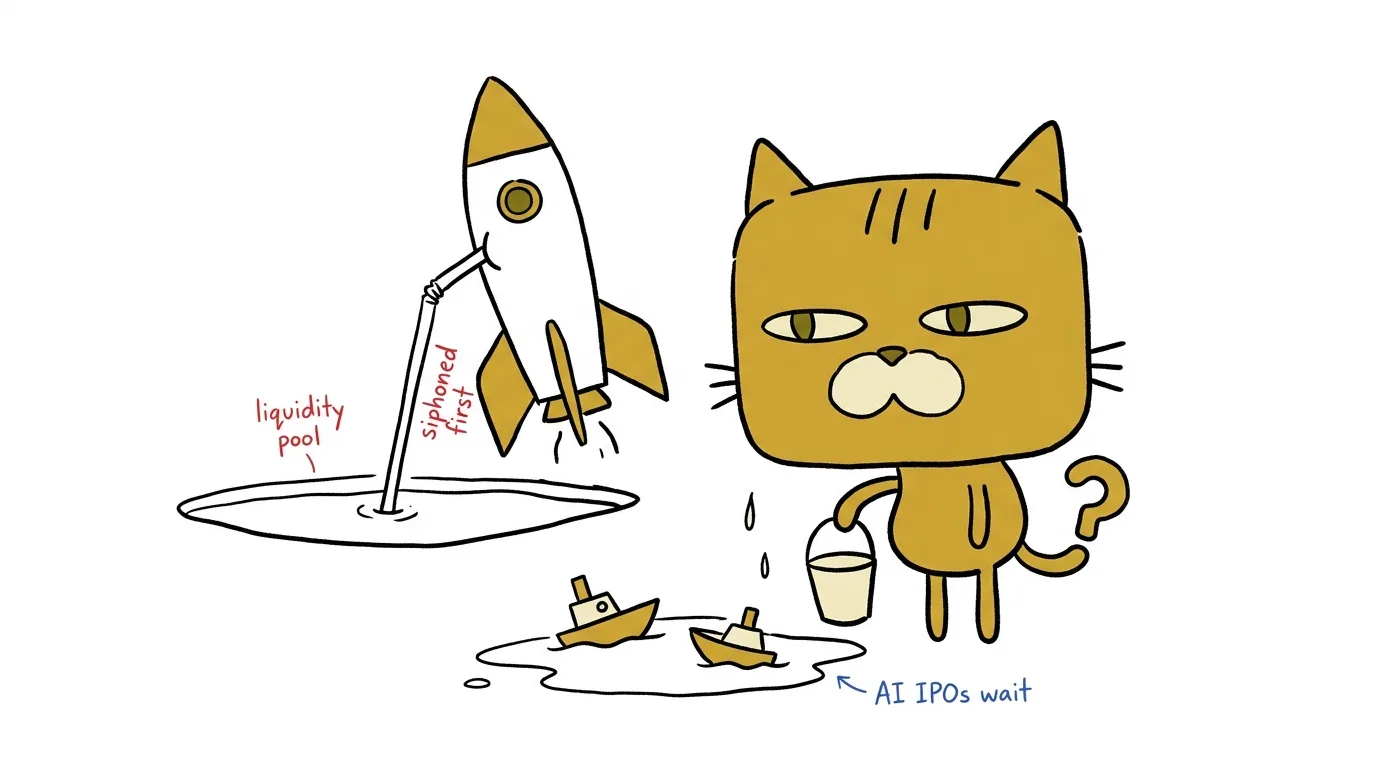
Even so, the largest securities offering in human history left deep marks on every AI company still queuing for the public market — a reference-point effect and a crowding-out effect at once.
First, institutional risk budgets are finite. Sovereign wealth funds, giant long-only funds, and retail allocation never had infinite room, and SpaceX drained close to $90 billion of real money in a single June stroke, raising the bar for every technology listing behind it. Second, the secondary market digested even this offering with visible difficulty. SpaceX brings hundreds of billions in mature Starlink cash flow plus a physical monopoly on launch — and still spent the months after listing oscillating sideways around $1.5 trillion rather than marching upward. The signal to the public market was unmistakable and chilling: even with genuine monopoly assets attached, appetite for trillion-dollar, capex-devouring heavy assets has a physical limit.
With the deepest layer of the liquidity pool claimed first, the cost of persuasion for a pure-AI narrative — Anthropic’s, then OpenAI’s — multiplied.
Anthropic: the steepest growth curve, and the scariest bill
Among the pure model companies, Anthropic is currently the sharpest — and most aggressive — specimen.
In late May it closed a $65 billion Series H at a $965 billion post-money valuation, including $15 billion in previously committed capital. Its revenue growth is close to unprecedented in software history: sources cited by Reuters put annualized run-rate revenue at roughly $9 billion at the end of 2025, jumping to $47 billion by May 2026 and crossing $65 billion by the end of July.
Precision matters here. A run rate annualizes a single month’s or quarter’s revenue into a full-year figure. It measures explosive force in the present tense. It is not booked annual revenue, and it is certainly not profit.
And the balance sheet expanded just as violently as the revenue line. Anthropic confidentially filed a draft S-1 in June, and the prospectus details reported by Reuters make remarkable reading: about $4.6 billion in actual 2025 booked revenue against an operating loss above $8 billion and a net loss near $42 billion — though some $34 billion of that is a non-cash accounting revaluation of preferred shares and convertibles as the valuation soared, not cash burned.
The number that will decide the company’s fate is neither revenue nor loss. It is the disclosed stack of multi-year cloud, compute, and datacenter obligations totaling roughly $518 billion — rigid future claims that exist regardless of how the revenue curve bends. Against that backdrop, Reuters reports Anthropic now seeks to raise up to $100 billion in an IPO targeting a valuation above $2 trillion, with Nvidia discussed as an anchor cornerstone investor and the window pushed past the November midterm elections.
Do the rough math: $65 billion of run-rate revenue against $2 trillion is a 31-times price-to-sales multiple. Even a sprint to $100 billion in run rate by year-end only compresses that below 20 times — and the entire edifice rests on one exacting premise: that future real free cash flow can fully cover a $518 billion compute debt.
Anthropic’s rush to list in November is a race against time in the most literal sense: fix the price of the era onto the balance sheet after SpaceX drained the market’s liquidity, but before the market starts panicking about a $42 billion paper loss.
OpenAI: the valuation sprints while cash flow chases behind
OpenAI sits at the same table with the same structural anxiety.
Data from Axios and Reuters in late September put OpenAI’s annualized recurring revenue near $70 billion, with enterprise sales roughly doubling since July. On the capital side, Bloomberg and others report negotiations for at least $30 billion in bridge financing at roughly a $1.4 trillion pre-money valuation.
At $1.4 trillion against $70 billion of run rate, the multiple is about 20 times — seemingly more conservative than Anthropic’s. But an internal long-range financial forecast obtained by the Financial Times and relayed by Reuters reveals the heavier reality: cumulative compute and infrastructure spending of roughly $856 billion between 2026 and 2030, the largest line item in company history; cumulative negative free cash flow of $278 billion over the same five years; and a revenue demand to match — about $36 billion in 2026 scaling to an almost inconceivable $350 billion in 2030, or roughly $840 billion cumulatively.
The message is plain: large models are rewriting the commercial physics of software companies. Classic internet software distributed at near-zero marginal cost. Every AI interaction — every multi-step agent rollout — burns GPU power, occupies compute, and depreciates high-bandwidth infrastructure. The AI company has mutated from a high-margin, asset-light software business into something stranger: software fused with energy-industrial plant.
That is the context for Sam Altman’s announcement that OpenAI will not list in 2026, pushing any IPO to 2027 at the earliest. The subtext is legible. With SpaceX having just absorbed $85.7 billion of net cash and Anthropic charging toward a $2 trillion November IPO, the public market cannot plausibly swallow two trillion-dollar capital furnaces in the same window. OpenAI steps aside, stays alive on private money, and watches Anthropic’s public-market price-discovery experiment from the sidelines: if Anthropic holds $2 trillion, OpenAI’s $1.4 trillion private story reignites; if Anthropic suffers multiple compression, the industry’s entire pricing regime gets rebuilt from scratch.
The trillion-dollar datacenter bet nobody can exit
This was never just a duel between two unicorns. Every hyperscaler has walked into the same prisoner’s dilemma in datacenters.
Goldman Sachs now puts 2026 consensus capital expenditure for frontier hyperscalers — Microsoft, Amazon, Google, Meta — at $800 billion, marching toward the trillion-dollar mark in 2027. Overseas infrastructure and legacy network upgrades take a share, but the bulk is AI compute clusters and their power systems.
Goldman’s scenario model states the return formula with accountant’s coldness: merely covering annual depreciation and operating costs on those datacenters requires roughly $300 billion a year in net-new global AI revenue; sustaining the giants’ historical ~30% return on invested capital demands an almost inconceivable $636 billion a year.
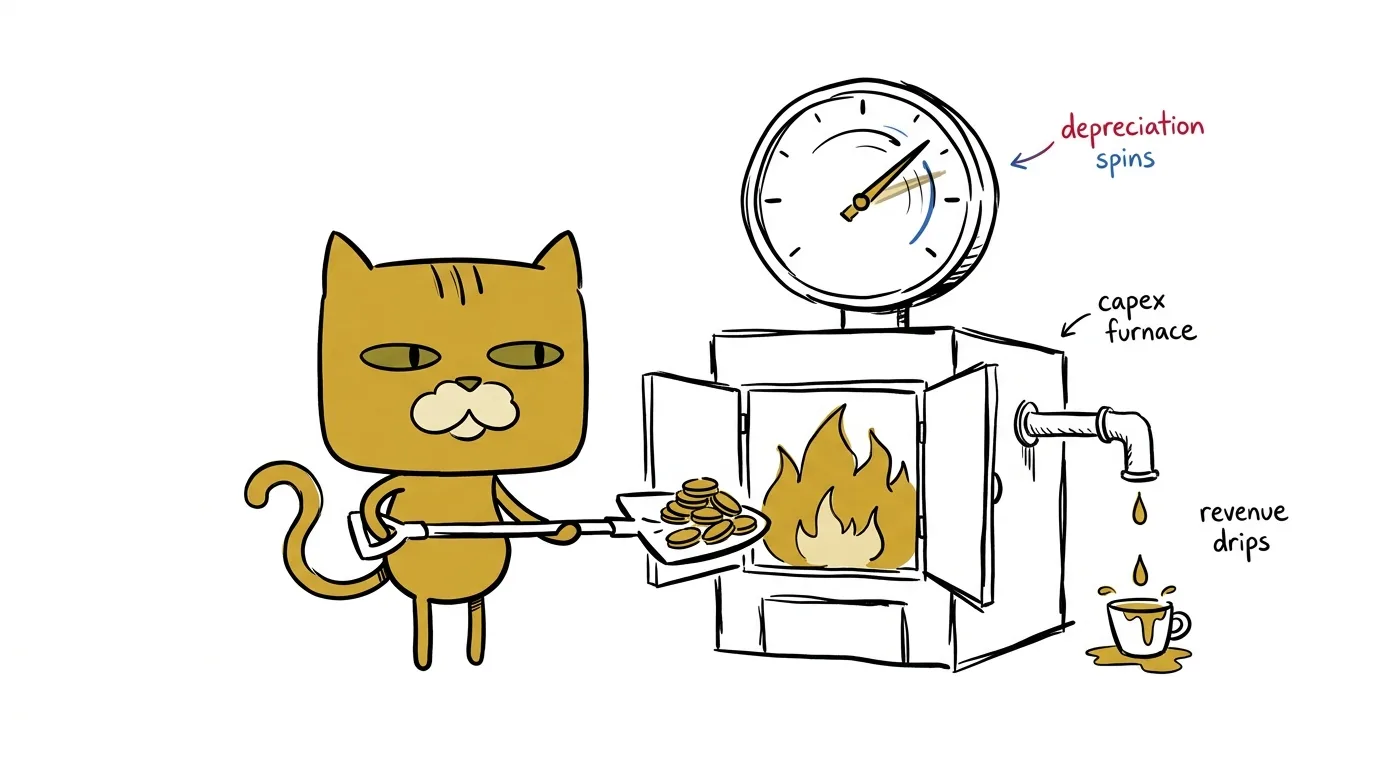
Hardware depreciation does not pause for market sentiment. Once machines are powered on, the charge hits the income statement every day, on schedule. If downstream software payments cannot keep pace with the buildout, that mountain of fixed-asset spending converts rapidly into a noose around the profit statement.
Agents are OpenAI’s lifeboat — and its newest cost center
With the macro picture in place, the seemingly irrational self-punishing acceleration of late September and early October becomes fully legible.
Twenty-dollar chat subscriptions cannot support a $350 billion 2030 revenue model, and they cannot absorb hundreds of billions in compute infrastructure either. OpenAI has to drag user behavior by force — from low-frequency Q&A into high-frequency, long-horizon, irreversible agent and code-engineering sessions. The arithmetic explains why: an ordinary user exchanging one question for one answer costs three seconds of inference and a few hundred tokens. A production Codex or Claude Code session — restructuring modules across a complex repository, standing up environments, running automated tests, correcting its own errors — can pull hundreds of thousands of context tokens and run a sandbox autonomously for hours. The compute consumed is tens or hundreds of times greater.
Whoever locks developers’ daily engineering flows and enterprises’ long-task pipelines inside its API system owns the most stable future revenue base available. Under pressure from Claude Code’s formidable developer mindshare — in a coding-agent market already strange enough to have split Windsurf into Google Antigravity and Devin Desktop — OpenAI had to move aggressively: rapid catch-up releases across Codex and Work through Dots, Computer Use, and the Agents API, in a product direction where persistent workspaces and computer use are converging into the same agent shape across the industry. The quota-reset pledge is best understood as engineered compute dumping plus guaranteed update cadence: ahead of a rival’s November IPO window, manufacture explosive call volume, hold high-value developers on the platform, and show prospective investors genuine demand capable of absorbing trillion-scale compute. I worked through the unit economics of that shift in my piece on the inference economics of Dots and GPT-6.1 Sol.
But it cuts both ways. Long-horizon agents are a source of premium enterprise fees — and a terrifying cost hole. If the market descends into a price war, with per-token model prices collapsing while call volumes double, the endgame turns cruel: furnaces roaring at full heat while revenue cannot cover the power and rent. The unglamorous defense is operational, and it starts before the invoice arrives: give agents bounded jobs and measure cost per completed task.
The most dangerous moment in a bubble is when the technology is real
Assemble the pieces. SpaceX banks $85.7 billion in net cash and sets a near-$2 trillion bar. Anthropic carries $518 billion in compute obligations and a $42 billion paper loss into a $2 trillion November IPO bid. OpenAI pairs an $856 billion infrastructure outlook with a $1.4 trillion private valuation and a 28-day no-rest death march. And hyperscaler power and server spending depreciates by the second.
This is the AI bubble’s most typical — and most dangerous — signature: nobody is paying for a scam; everybody is betting on a genuinely world-transforming technology.
The capital markets of 1999 were not wrong about the internet. The internet did remake the world. Yet many investors of that era still lost everything, because the market’s real error was different: discounting ten or twenty years of forward profits into present-day prices in full, while underestimating how heavy assets and brutal competition would erode margins.
A rupture this time most likely arrives not through technological failure but through a slow stampede in leverage and cash flow:
- Insufficient market liquidity. After SpaceX drained the pool, if secondary buyers cannot digest Anthropic’s $2 trillion print, the industry’s valuation regime reprices downward as a system.
- Price wars devour real margins. Open models keep closing in, inference unit prices collapse, and soaring call volumes fail to convert into commensurate profit.
- Any wobble in the growth myth. The quarter ARR growth decelerates from 300% to 60%, Wall Street’s model flips in an instant — from dream-building to discounted free cash flow.
- Capex reversal. Borrowing costs climb, trillion-dollar buildout budgets get cut, hardware and datacenter orders slip, and the negative feedback loop closes.
The stress test has already started
In this light, OpenAI’s manic 28-day sprint, its quota-reset wager, and its concentrated product barrage look nothing like managerial impulse.
They are the opposite: the coldest, most extreme rational defense available to a company perched on a trillion-dollar valuation with the capital cycle tightening and giants ahead already draining liquidity. Paper valuation must become product stickiness at maximum speed; call volume must harden into irreplaceable enterprise workflows. On this cliff-edge arena, slowing by half a step lets the capital and depreciation bills behind swallow the entire myth in an instant.
For builders, the implication is practical rather than prophetic: choose platforms by demonstrated inference economics and workflow lock-in, not by launch-cadence theater. For everyone else, mark the calendar — November’s IPO window is when the industry’s pricing regime meets its first real buyer. The full stress test has formally begun.