Apple AI Strategy: Who Controls the Next Action?
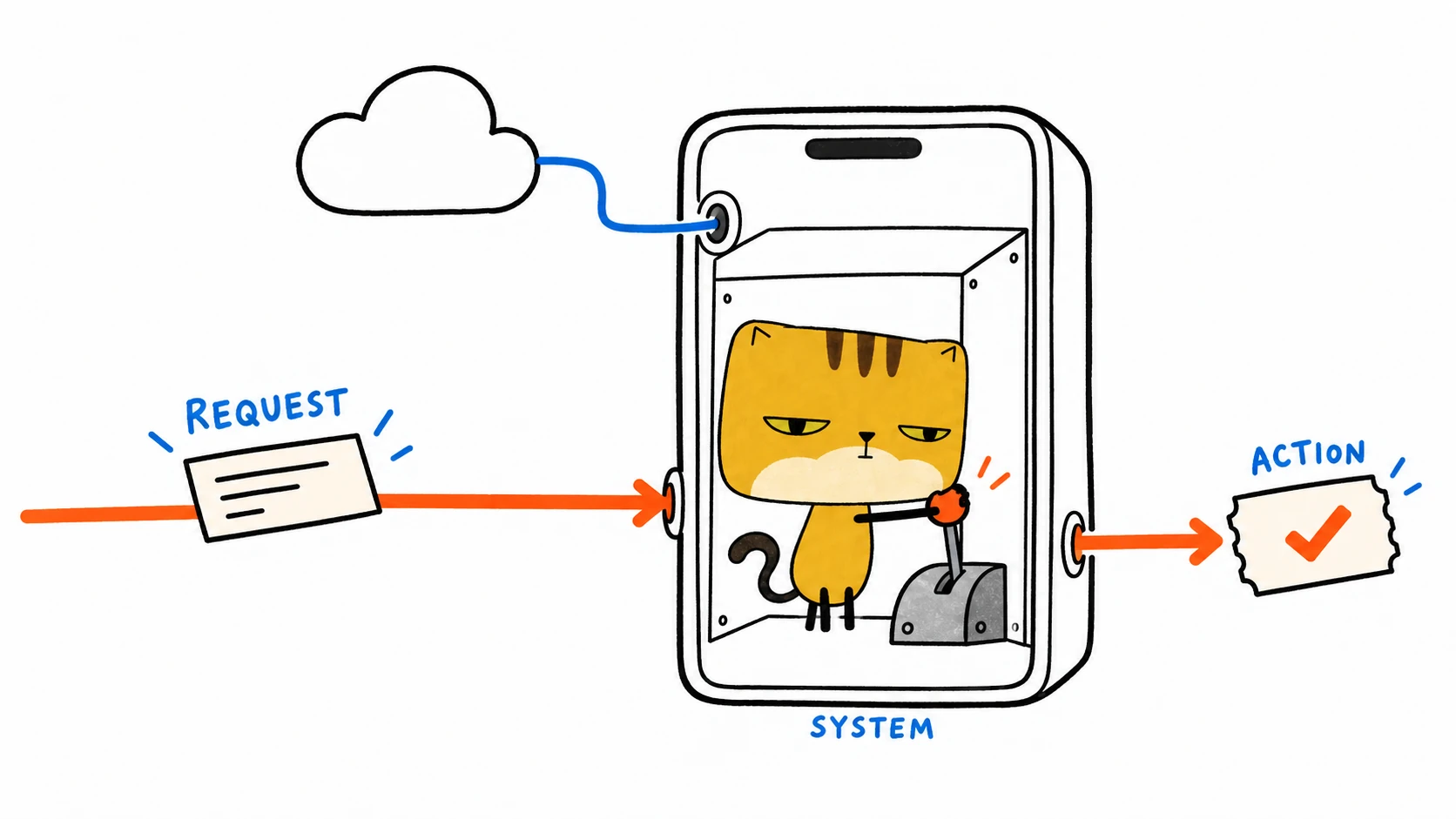
Apple’s AI strategy is increasingly about controlling what happens after a prompt: the context, app interfaces and execution rules that turn a request into an action. Apple Foundation Models and Siri AI are parts of that platform strategy. Model partnerships can supply capabilities, but reliable task completion still depends on the system around them.1 2 3
In late September, Apple researchers published SCLATE, a paper about the infrastructure needed to train and evaluate agents over extended periods. It asks how work resumes, how memory is maintained and whether an agent can still use an earlier lesson days later.4
SCLATE does not establish how Siri is implemented. It does, however, add a research perspective to Apple’s documented products, developer tools and partnerships: the multiyear Google collaboration announced in January, the model family and developer frameworks detailed in June, and Siri AI’s English-beta rollout in September.1 2 5 3
My reading of these developments is that Apple is investing in the path from a user’s request to an application’s completed action. Owning the device gives it a strong position along that path; reliability still has to be demonstrated.
What Apple still controls after partnering with Google
The January 12 joint statement was explicit: the next generation of Apple Foundation Models would be based on Google’s Gemini models and cloud technology. This is a deeper relationship than adding a button that forwards questions to an external chatbot. By June, Apple’s third-generation model family covered both devices and servers, with AFM 3 Cloud Pro intended for demanding reasoning and agentic tool use.1 2
Apple also announced that Private Cloud Compute, or PCC, would extend to NVIDIA GPUs in Google Cloud. Its published design retains Apple’s control of PCC software, with devices trusting only software cryptographically approved by Apple.6
Apple accepts external participation in models and compute while retaining control over system integration and the mechanisms that establish trust. Model quality and system design both matter to the resulting product.
Dependence does not disappear. A partner’s capabilities, supply terms and release cadence can affect the resulting product. The strategic challenge is to use that capability without allowing one supplier to define the entire user experience. That is an interpretation of the public architecture, not a claim about undisclosed contractual arrangements.
A separate boundary matters for developers: PCC’s privacy commitments do not automatically extend to every third-party model used through Apple’s APIs. Apple’s developer material explicitly warns that models have different privacy characteristics and that users need to understand which they are receiving.7
What Foundation Models and App Intents expose
In 2025, the Foundation Models framework opened on-device inference, structured generation and tool calling to applications. The WWDC26 material goes further: switching models within a session, changing the available tools, transforming conversation history and carrying state between phases of a workflow.8 9
These capabilities address recurring workflow problems. What happens when context grows too large? Does a simple request need a server model? Which information should cross a model boundary? What state should remain after an interrupted operation?
Apple also introduced an open-source utilities package for agentic patterns that can evolve between major operating-system releases. The company is exposing building blocks for application developers rather than requiring every experience to resemble one fixed assistant.9
App Intents handles the application side. Developers describe application objects and actions in forms the system can understand. Spotlight makes content discoverable; schemas connect natural-language requests to operations; view annotations associate visible content with application entities.5 10
For supported functionality, this creates an opportunity to invoke a defined operation instead of inferring every action from pixels and coordinates. Coverage still depends on what developers actually expose. Recognizing an application’s name is a long way from being able to operate all of it. This is the same interface choice discussed in my analysis of OpenClaw and Big Tech’s agent architectures: defined tools can handle supported actions, while computer use fills some of the gaps.
Applications can use different models through Apple’s framework while making their own capabilities available to the system. This gives Apple a role in both model access and application actions, even when the models come from elsewhere.
These APIs do not establish Siri’s internal orchestration. They are published capabilities for developers; their existence does not prove that every component belongs to one unified personal-agent implementation.
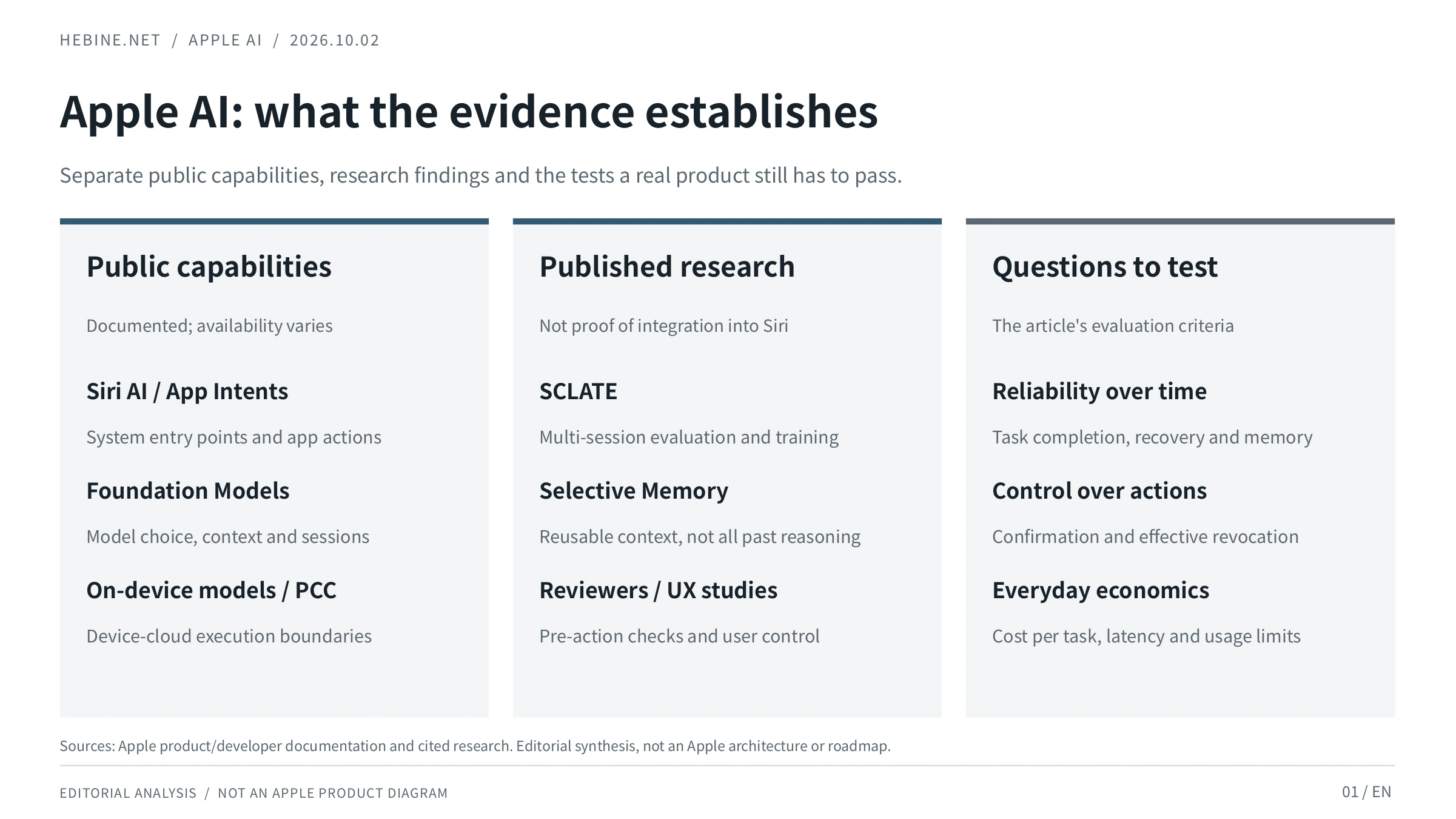
Figure 1. Evidence map supplied by Gebi Maoshu / hebine.net. It separates documented capabilities, research and questions requiring further validation. The layout does not represent Apple’s internal architecture or establish that the research has shipped in Siri.
SCLATE separates long-running evaluation from training
SCLATE addresses a gap that appears when an agent is used repeatedly.
An agent may complete a task today and lose an important convention when its next session starts. It may save information successfully and never retrieve it when needed. A one-off task score provides limited visibility into either failure.
SCLATE puts benchmark events and agent-side events—such as session transitions, scheduled work and memory maintenance—on a shared timeline. In its MetaClaw experiments, a scenario spanning 40 calendar days finished in a median of 5.9 hours. The mechanism skips idle intervals; it does not suddenly accelerate the model’s actual reasoning.4
In a separate single-session experiment, researchers post-trained Qwen3.5-4B on SWE-Gym using Group Relative Policy Optimization (GRPO) through unmodified harnesses: the frameworks managing tools, context and execution. Evaluated on SWE-bench Verified, Pass@1 rose from 9.8% to 26.5% under Claude Code and from 28.8% to 33.6% under Codex. Those results do not come from the 40-day MetaClaw simulation.4
Reporting both results is more informative than isolating the larger improvement. Training gains depend on how the model initially uses its environment, and the starting point differs across harnesses. These measurements do not establish a universal ranking of the two frameworks.
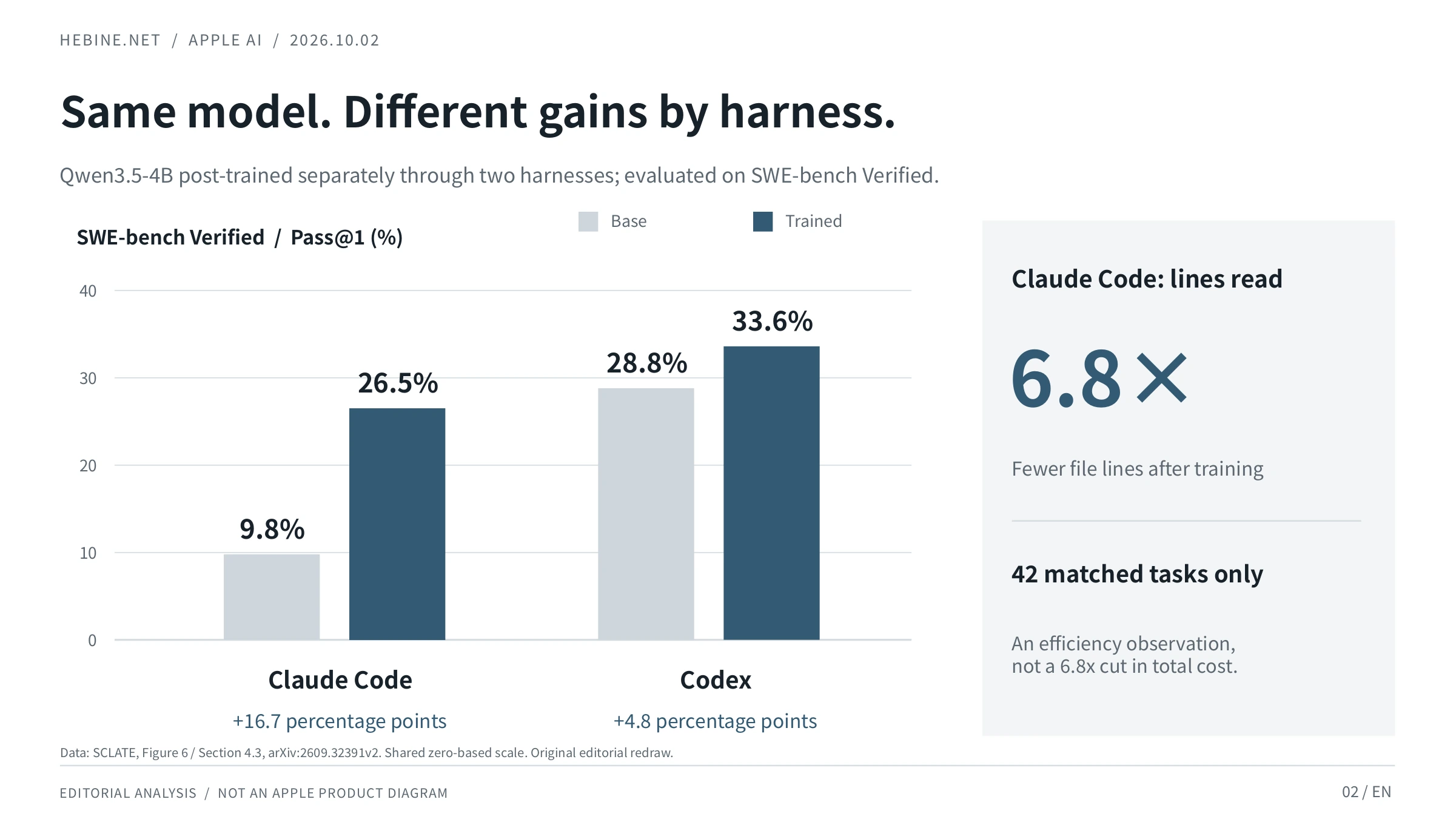
Figure 2. Editorial redraw supplied by Gebi Maoshu / hebine.net, based on SCLATE Figure 6 and Section 4.3. The 6.8-fold reduction in code lines read was measured on 42 matched evaluation tasks under Claude Code. It is not a measurement of an equivalent reduction in total tokens, inference time or service cost.
For Apple, the implication is that optimization can reach into how a model handles its tools and context. Leading a general benchmark is not a prerequisite for improving a particular workflow. But a capable underlying model, representative tasks and sound evaluation remain necessary.
Two mechanisms also need to stay separate. Writing information into memory during execution is different from updating model weights using recorded trajectories. SCLATE demonstrates a training loop involving the latter. It does not show that Siri on an iPhone continuously retrains itself, or that private user histories are being used for those updates.4
Selective memory needs rules for forgetting
A personal agent is easy to imagine as an assistant that never forgets. Engineering that system requires considering what happens when it remembers the wrong thing.
Apple researchers’ Shared Selective Persistent Memory work retains reusable task specifications, data schemas, tool configurations and output constraints while dropping session-specific reasoning. First submitted in July and revised in September, it studies collaborative workspaces that generate and maintain code artifacts—not Siri’s memory of a person’s life.11
The useful design question is whether retained information remains reusable, rather than how much history can be stored. The enterprise evaluation covered only 24 recurring tasks. No pairwise completion-rate difference survived correction for multiple comparisons. The findings should not be promoted into a universal law of agent memory.11
The harder product questions extend beyond that experiment. A change of workplace should invalidate an old commuting assumption. A temporary instruction should not silently become a permanent preference. Work information should not move into a family context merely because it is retrievable. These are requirements proposed here, not capabilities this research establishes for Siri.
Memory therefore needs provenance, scope and conditions for expiry. Users also need ways to inspect, correct and revoke information before trusting it to influence future actions.
Synchronizing conversation history across devices enables continued access to the past. Selective memory and learning from experience require considerably more.
Reviewers and computer-use studies test different risks
Other Apple research addresses parts of the reliability problem.
AutoPlay explores interactive environments to generate training tasks. Agent Seer constructs evaluation scenarios from MCP tool specifications, using synthetic tool outputs rather than demonstrating successful execution against live services. Both seek to reduce the work involved in producing training and evaluation material.12 13
Reinforced Agent moves review ahead of tool execution. A reviewer evaluates proposed calls, and the study measures both corrections and cases where feedback makes a correct decision worse. The reviewer itself can introduce errors.14
Adding another agent does not remove system responsibility. Checking a recipient before sending a message is valuable. An unreliable check that repeatedly interrupts the user or adds substantial delay may make the workflow unusable.
Apple’s computer-use UX research also examines control and risk. After interviewing practitioners, researchers ran a study with 20 participants in which a researcher simulated the agent. This is evidence about interaction design, not real-world safety validation of an autonomous product.15
Taken together, the studies point to recurring engineering questions: how to construct meaningful tests, detect errors before action and give users effective control. Their thematic overlap does not establish a single, coordinated internal product roadmap.
Privacy and action safety must also remain distinct. PCC addresses protection of data during computation. It does not by itself ensure that a message goes to the correct recipient or define the circumstances under which an agent may delete a file. Confirmation, recovery and revocation require additional system design.6
Device and cloud models change the cost of each task
The cost of a personal agent is not limited to the answer a user sees.
A workflow can involve retrieval, planning, tool calls, checking and memory maintenance. Additional checks and background work require more computation. Sending every step to a large model can also increase latency. Persistent assistance makes these trade-offs difficult to avoid. I explored the broader business problem in the economics of OpenAI Dots and personal agents; Apple’s device-cloud split is one way to manage that workload.
Apple’s model family already reflects a division of work. Its on-device options include the roughly 3-billion-parameter AFM 3 Core and AFM 3 Core Advanced, with about 20 billion total parameters and roughly 1–4 billion active for a request. Server models handle more demanding workloads. Total and active parameters are different quantities, and the larger on-device model is not supported on every compatible device.2
Local execution can reduce server calls. It still consumes memory, power and time. The useful optimization target is the resource cost of completing a valuable task, including the steps that produce no visible answer.
Product restrictions make that accounting concrete. Apple’s September 14 release says that certain server-backed features, including Siri AI, have daily usage limits and that expanded access will be offered for a fee in the future. It does not provide enough published pricing information to infer a uniform subscription package.3
The developer arrangement differs. The WWDC26 guide describes access to PCC models at no cloud API cost for developers enrolled in the App Store Small Business Program whose applications have fewer than two million total first-time downloads. This is a conditional program, not a promise of unlimited free inference for any application.5
My interpretation is that Apple has a platform incentive to provide such capabilities. But the absence of an individual API bill does not eliminate the underlying resource cost. How proactive an assistant can afford to be will depend partly on how that work is scheduled and constrained.
Where the operating-system advantage stops
Another paper hosted on Apple’s research site tests how much extra orchestration helps a strong model.
In How Much of a Harness Does a Strong Agent Need for Autonomous ML Engineering?, the researchers find that none of the tested harnesses significantly outperformed a minimal coding-agent baseline under matched model, hardware and time budgets. The result concerns the machine-learning engineering tasks studied; it cannot simply be transferred to personal assistants. It does challenge the intuition that additional orchestration necessarily creates a stronger agent.16
Apple has to improve model capability and system reliability together. A default entry point reduces the friction of trying a product. It does not make an incorrect result acceptable. Repeated explanation and manual repair are unlikely foundations for a durable user habit.
The operating-system advantage also has limits. App Intents relies on developer participation. Information may live across services, and cross-platform work may not fit comfortably inside one device ecosystem. The public interfaces establish an integration approach, not that these constraints have disappeared.10
Availability changes the practical value as well. The September release describes an English-beta rollout, excludes China initially and does not initially make Siri AI available on iOS, iPadOS or watchOS in the EU. Language, region and hardware restrictions mean that “Apple has released it” does not imply that every user can access it.3
How to test Apple’s personal-agent strategy
The useful test is task completion over time.
Watch whether a cross-application task actually finishes and whether a failed operation can recover. Extend the test over several weeks: does the system retain valid instructions, retire obsolete ones and stop acting when permission is withdrawn? Then measure how much useful work it can complete within acceptable latency and usage limits.
Research papers and product announcements cannot supply those answers on their own. Independent, reproducible task-level testing is still needed.
Apple’s model partnerships, device-cloud architecture, application interfaces and agent research expand the role its operating system can play in getting work done.
When a user expresses a goal before choosing an application, the operating system starts participating in the task itself. Apple is investing in that position.
SCLATE supplies a research tool for testing reliable operation over time. To judge the product strategy, test a repeated cross-app task: completion, recovery, retained instructions, revoked permissions and resource cost. Users’ willingness to delegate the next action will depend on those results.
Research cutoff: October 2, 2026. Product and API descriptions rely primarily on official documentation; research findings are limited to the experiments reported. Strategic interpretations are the author’s analysis. This article does not include an independent hands-on evaluation of the new Siri or treat research projects as confirmed product implementations.
Adapted by Jack from the English draft and original editorial figures supplied by Gebi Maoshu / hebine.net, dated October 2, 2026.
Footnotes
-
Google and Apple. Joint statement from Google and Apple. 2026-01-12. Official multiyear collaboration announcement; financial terms are not established here. ↩ ↩2 ↩3
-
Apple Machine Learning Research. Introducing the Third Generation of Apple’s Foundation Models. 2026-06-08; page updated 2026-09-09. Model family, parameter counts, target hardware and intended uses are Apple’s published descriptions. ↩ ↩2 ↩3 ↩4
-
Apple Newsroom. Siri AI, a profoundly more capable and personal assistant, is here. 2026-09-14. Product rollout, system orchestrator, availability and usage limits. Announced functionality is not an independent reliability assessment; future features remain future features. ↩ ↩2 ↩3 ↩4
-
Youngmok Jung et al., Apple. SCLATE: A Substrate for Continual-Learning Agent Training and Evaluation. arXiv v1: 2026-09-26; v2: 2026-09-29. Sections 4.1–4.3; Figure 6; Table 2. Code-reading efficiency: 42 matched Claude Code tasks. Research results, not Siri product measurements. ↩ ↩2 ↩3 ↩4
-
Apple Developer. WWDC26 Apple Intelligence guide. WWDC26; accessed 2026-10-02. Foundation Models, App Intents and conditional no-cloud-API-cost PCC access. Eligibility does not imply unlimited capacity. ↩ ↩2 ↩3
-
Apple Security Research. Expanding Private Cloud Compute. 2026-06-08. Announced Google Cloud/NVIDIA extension, privacy requirements and software control. The post describes a preview ramp; this article does not claim an independent audit or universal availability. ↩ ↩2
-
Apple Developer. Bring an LLM provider to the Foundation Models framework. WWDC26; accessed 2026-10-02. Third-party provider interfaces and the differing privacy characteristics of local and cloud models. ↩
-
Apple Newsroom. Apple’s Foundation Models framework unlocks new intelligent app experiences. 2025-09-29. Historical baseline: on-device access, guided generation and tool calling. ↩
-
Apple Developer. Build agentic app experiences with the Foundation Models framework. WWDC26; accessed 2026-10-02. Dynamic profiles, transcript management, lifecycle state, orchestration patterns and the utilities package. These developer APIs do not establish Siri’s internal implementation. ↩ ↩2
-
Apple Developer. Build intelligent Siri experiences with App Schemas. WWDC26; accessed 2026-10-02. Application entities, schemas, discoverability and actions; capabilities depend on app integration. ↩ ↩2
-
Sanjana Pedada, Aditya Dhavala and Neelraj Patil, Apple. Shared Selective Persistent Memory for Agentic LLM Systems. arXiv v1: 2026-07-10; v2: 2026-09-15. Use the revised paper rather than the shorter research-site abstract. Enterprise evaluation: 24 recurring tasks; no pairwise completion-rate difference significant after multiple-comparison correction. The domain is collaborative artifact generation, not personal Siri memory. ↩ ↩2
-
Apple Machine Learning Research. Scaling Synthetic Task Generation for Agents via Exploration. Research-site publication: March 2026. AutoPlay explores interactive environments to generate training tasks. This is research, not an announcement of autonomous iOS operation. ↩
-
Apple Machine Learning Research. Agent Seer: Synthesizing Scenarios from Specification Understanding. Research-site publication: August 2026. MCP-specification-based scenario generation with synthetic tool outputs; not live tool execution. ↩
-
Apple Machine Learning Research. Reinforced Agent: Inference-Time Feedback for Tool-Calling Agents. Research-site publication: May 2026. Pre-execution reviewer and helpfulness/harmfulness trade-off. Review can introduce errors. ↩
-
Apple Machine Learning Research. Mapping the Design Space of User Experience for Computer Use Agents. Research-site publication: February 2026. Eight practitioner interviews and a 20-participant Wizard-of-Oz study; interaction research, not an autonomous-agent safety trial. ↩
-
Kirill Brilliantov, Alejandro Hernández-Cano and Emmanuel Abbé. How Much of a Harness Does a Strong Agent Need for Autonomous ML Engineering?. arXiv: 2026-09-30; Apple research site: 2026-10-01. Matched-model, hardware and time comparison in the studied MLE setting; no tested harness significantly outperformed the minimal baseline. Do not generalize to all personal agents or all harnesses. ↩