GPT-5.6 Sol vs. Terra vs. Luna: Which Should You Use?

My default split is simple: use GPT-5.6 Luna for bounded, repeatable work, GPT-5.6 Terra for the faster middle tier, and GPT-5.6 Sol when the task is ambiguous or expensive to get wrong.
That recommendation comes from a fresh August 4, 2026 snapshot of CodexRadar’s leaderboard and intelligence-efficiency data. The efficiency feed reports source_updated_at as 2026-08-04T00:33:44+08:00; I fetched the leaderboard on the same day. The two endpoints measure different things. The leaderboard uses repeated task votes; the efficiency feed uses the latest valid run for each task. Treating them as the same score makes the model tiers look more certain than they are.
The practical answer
For an agent workflow, start with the risk and the acceptance test. Use Luna xhigh for volume and Luna max for harder bounded coding work. Use Terra xhigh when you need a quick middle tier and Terra max when the task needs more room. Use Sol xhigh for ambiguous requirements and difficult integration; reserve Sol ultra for high-consequence work where the extra passes justify the bill.
The snapshot below uses two scoring views. “Majority passes” comes from the leaderboard. “Latest-run IQ” comes from the efficiency feed and equals the latest-run pass rate multiplied by 150. Cost and time are averages of the latest valid runs, expressed as token-price-equivalent API dollars and minutes.
| Configuration | Majority passes | Latest-run IQ | Avg. cost | Avg. time |
|---|---|---|---|---|
| GPT-5.6 Sol xhigh | 77 / 112 | 104.5 | $6.16 | 25.5 min |
| GPT-5.6 Sol max | 76 / 112 | 105.8 | $9.53 | 34.4 min |
| GPT-5.6 Terra xhigh | 64 / 112 | 84.4 | $1.84 | 18.3 min |
| GPT-5.6 Terra max | 68 / 112 | 95.1 | $4.02 | 31.6 min |
| GPT-5.6 Luna xhigh | 67 / 112 | 89.7 | $0.31 | 22.1 min |
| GPT-5.6 Luna max | 71 / 112 | 101.8 | $0.47 | 33.2 min |
These are API-style token-cost estimates from CodexRadar. They describe model usage, not a subscription meter. Some duration or cost samples are incomplete for individual cells, so treat the figures as comparisons, not fixed per-task bills.

Why the two CodexRadar scores disagree
The leaderboard answers a stability-oriented question: how many tasks does a model pass when a task has repeated votes? In the current rows above, each task cell has three votes, and the majority result requires at least two passes. That makes the score less sensitive to one lucky or unlucky attempt.
The efficiency feed answers a second question: what happened on the latest valid run for each task, and what did that run cost and take? Use its IQ as a current-run signal; use majority passes when repeated-task stability matters.
The gap is visible in the latest snapshot:
- Sol xhigh is close: 77 majority passes versus 78 latest-run passes.
- Terra max shows a larger difference: 68 majority passes versus 71 latest-run passes.
- Luna max shows a five-task gap: 71 majority passes versus 76 latest-run passes.
- Sol ultra goes the other direction: 82 majority passes versus 78 latest-run passes.
Those differences can reflect run variance, changing task cells, or timing differences between the two feeds. Read Luna max’s 101.8 IQ as a recent-run signal; its 71 majority passes are the more cautious stability figure.
The efficiency feed also publishes a combined cost index. Its formula multiplies average price by a strongly weighted duration term, with a time exponent of about 3.05, then normalizes the largest valid point to 100. This article reports raw price, time, and IQ because a team that values latency differently would make a different choice.

What changes when you raise reasoning effort
The effort setting matters almost as much as the model tier. The current leaderboard majority counts are:
| Effort | Luna | Terra | Sol |
|---|---|---|---|
| low | 5 / 112 | 31 / 112 | 52 / 112 |
| medium | 18 / 112 | 41 / 112 | 66 / 112 |
| high | 48 / 112 | 60 / 112 | 68 / 112 |
| xhigh | 67 / 112 | 64 / 112 | 77 / 112 |
| max | 71 / 112 | 68 / 112 | 76 / 112 |
| ultra | — | 74 / 112 | 82 / 112 |
Luna and Terra improve steadily as effort rises in this snapshot. Luna moves from 5 majority passes at low to 71 at max, while Terra moves from 31 to 68. That makes the extra reasoning budget meaningful when the task remains within the model’s capability range.
Sol is less tidy. Its xhigh row passes 77 tasks, one more than max, while ultra reaches 82. The latest-run IQ tells a different story: Sol xhigh and ultra both land at 104.5, while max reaches 105.8. Xhigh remains the practical Sol default; ultra’s five additional majority passes come with a very large resource bill.
This fits the result in my Sol max versus xhigh analysis: each effort setting buys a different reasoning budget, and its return depends on the task mix and the run distribution.
Cost, quality, and the decision
At xhigh, Terra costs about 70% less than Sol and Luna costs about 95% less than Sol in the latest efficiency snapshot. Luna xhigh is also faster than Sol xhigh: about 22.1 minutes versus 25.5 minutes. Terra xhigh is the fastest of the three at about 18.3 minutes, but it passes fewer majority tasks than either Luna xhigh or Sol xhigh in this repository sample.
At max, Luna costs roughly 95% less than Sol and Terra costs roughly 58% less than Sol. Luna max’s 71 majority passes are three above Terra max’s 68, while its latest-run IQ is also higher. That result is specific to this task set, this snapshot, and these two scoring views.
The useful takeaway is practical: the price cut makes it cheap enough to try Luna on work where failure is easy to detect. The economics only help when the system can recognize a bad result before it becomes an expensive downstream mistake.
A routing rule that survives the data
The safest router is based on uncertainty and verification:
- Can the task stay Direct? If it is a small, obvious change, do it in the current context. A model handoff would add overhead without buying useful separation.
- Can a test or deterministic check recognize success? If yes, Luna xhigh is a sensible first worker for a high-volume or tightly scoped task.
- Does the task need more reasoning but still have clear edges? Try Luna max or Terra max, depending on whether cost or breadth matters more.
- Is the goal ambiguous, the integration shared, or the failure hard to observe? Keep the planning and final decision with Sol. Do not ask a cheap worker to invent the acceptance criteria.
- Did the verifier reject the first result? Escalate with the failure evidence. Do not blindly relaunch the same prompt and call the second attempt a new strategy.
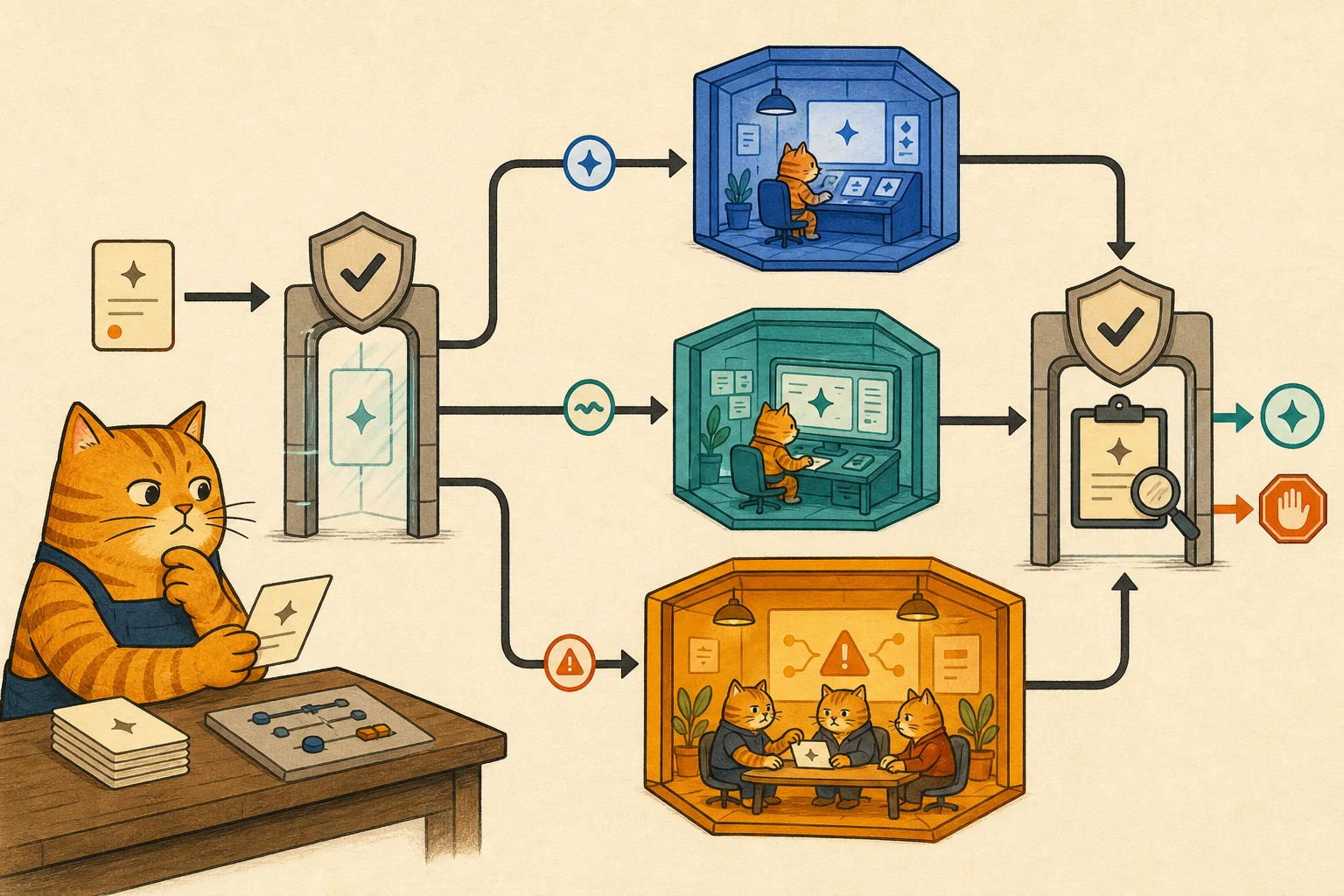
For my Codex workflow, the numbers lead to a division of labor. Sol defines the goal, acceptance criteria, and integration boundary. Luna handles bounded execution where a test can say whether the patch works. Terra is a middle escalation for work that needs more room without Sol’s full premium. Sol reviews the real diff and keeps the final decision.
That pattern is close to the setup described in How to Use GPT-5.6 Luna Max as a Codex Subagent. The current data makes verification the deciding factor: a cheap worker helps when its result can be checked before it creates downstream rework.
Final recommendation
The effort table sharpens the opening split. Luna max adds four majority passes over Luna xhigh for $0.16 more and about 11 extra minutes. Terra max also adds four passes over Terra xhigh, but costs $2.18 more and takes about 13 minutes longer. Sol xhigh remains the practical default: it passes one more majority task than Sol max while costing $3.37 less and finishing about nine minutes sooner. Sol ultra adds five majority passes over xhigh, at roughly $15.92 more and 28 extra minutes.
Pick the lowest row that clears the task’s acceptance and verification bar. That usually means Luna for bounded work, Terra for a middle escalation, and Sol for ambiguity or high-consequence judgment.
The practical question is: which model is the cheapest one that clears this task’s quality and verification bar? That choice keeps the workflow fast without turning a low API price into a high rework bill.