Claude Opus 5 vs. Claude Fable 5: Eight Tests, Same Prompts
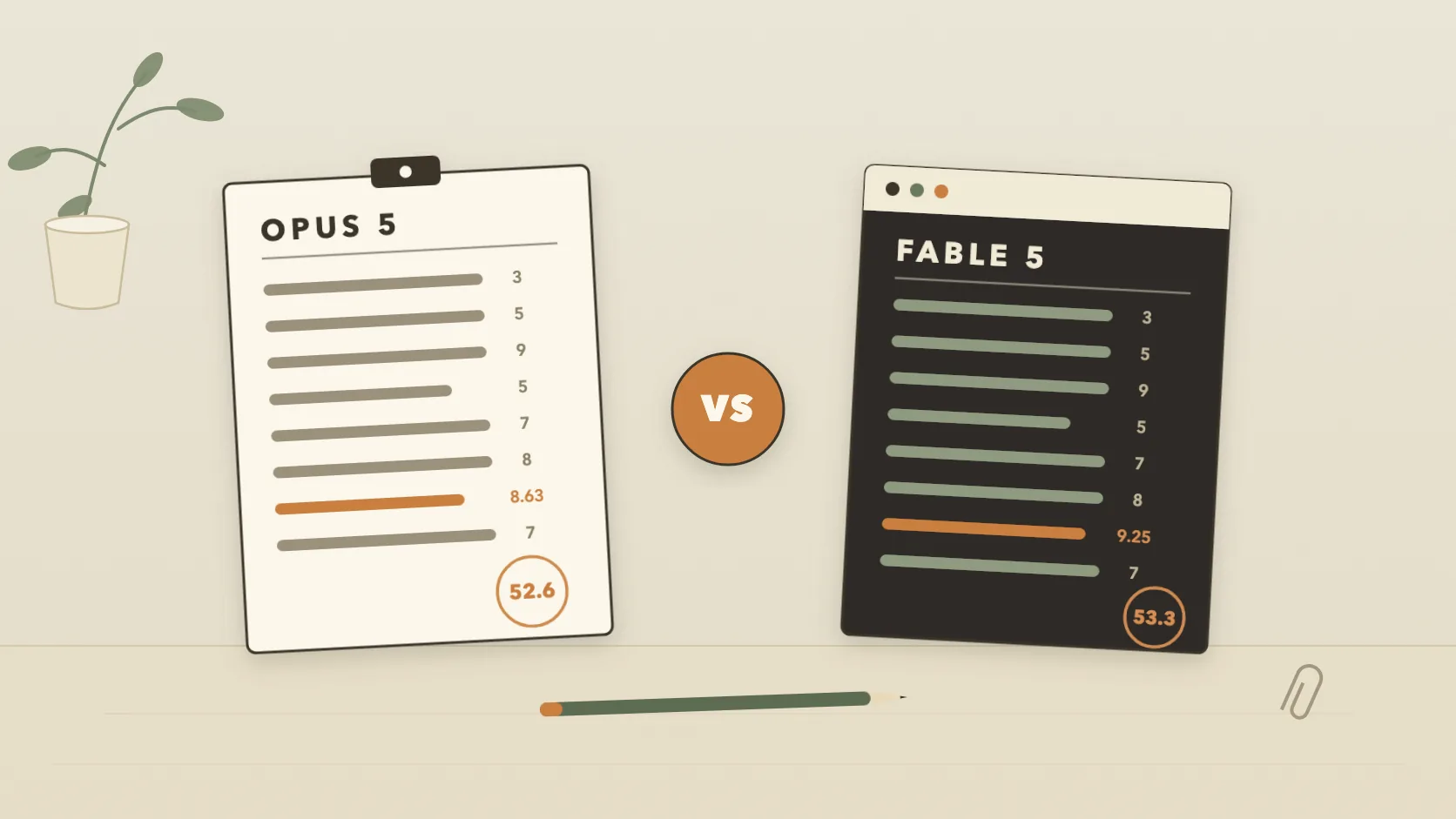
Fable 5 is Anthropic’s new Mythos-tier model. It sits above Opus and costs twice as much: $10/$50 versus $5/$25 per million tokens. Yet on July’s public leaderboards, Opus 5 led on most benchmarks: 43.3% versus 33.7% on Frontier-Bench and 61 versus 60 on Artificial Analysis. Fable 5’s stronger areas were SWE-bench Pro (80.0 versus 79.2) and long-horizon autonomous tasks.
Leaderboards are useful, but I wanted a smaller test of my own. I ran both models under exactly the same prompts and working conditions to see whether the difference showed up in ordinary work.
Note: This is a personal test with one run per task (n=1). It cannot measure variance, so treat the results as directional rather than rigorous.
Method
- Environment: Claude Code’s Agent tool, with
model=opusandmodel=fable. Both received identical prompts. - Eight tasks: mathematical reasoning, constraint solving, algorithm implementation, bug hunting, instruction following, information extraction, a decision memo, and an agentic file-processing task.
- Scoring was as mechanical as possible. I verified math and logic answers by brute force, ran algorithms against nine hidden pytest cases, and used scripts for instruction-following and ETL outputs.
- The only subjective task, the decision memo, used two blind judges. Sonnet and Opus each reviewed a pair with the A/B order reversed, without knowing which model wrote either memo.
Results
| Test | Max | Opus 5 | Fable 5 |
|---|---|---|---|
| T1 Mathematical reasoning, no tools | 3 | 3 | 3 |
| T2 Constraint solving, no tools | 5 | 5 | 5 |
| T3 Algorithm implementation, hidden tests | 9 | 9 | 9 |
| T4 Bug hunting, six seeded bugs | 6 | 5 | 5 |
| T5 Instruction following, seven hard constraints | 7 | 7 | 7 |
| T6 Information extraction and date calculation | 8 | 8 | 8 |
| T7 Decision memo, blind review | 10 | 8.63 | 9.25 |
| T8 Agentic ETL | 7 | 7 | 7 |
| Total | 55 | 52.63 | 53.25 |
Total runtime was nearly identical: 344.1 seconds for Opus 5 and 332.5 seconds for Fable 5.
What changed between the models
The objective tasks were tied, including the missed bug
Both models scored 44 out of 45 on the objective tasks. Each found the same five of six seeded bugs and missed the same one: int(latency_s) silently discarded records with decimal latency values. It should have used float.
At least in this test, their blind spot was identical. Both caught the conspicuous bugs and missed the quieter failure where a type conversion caused data loss.
Their working styles were different
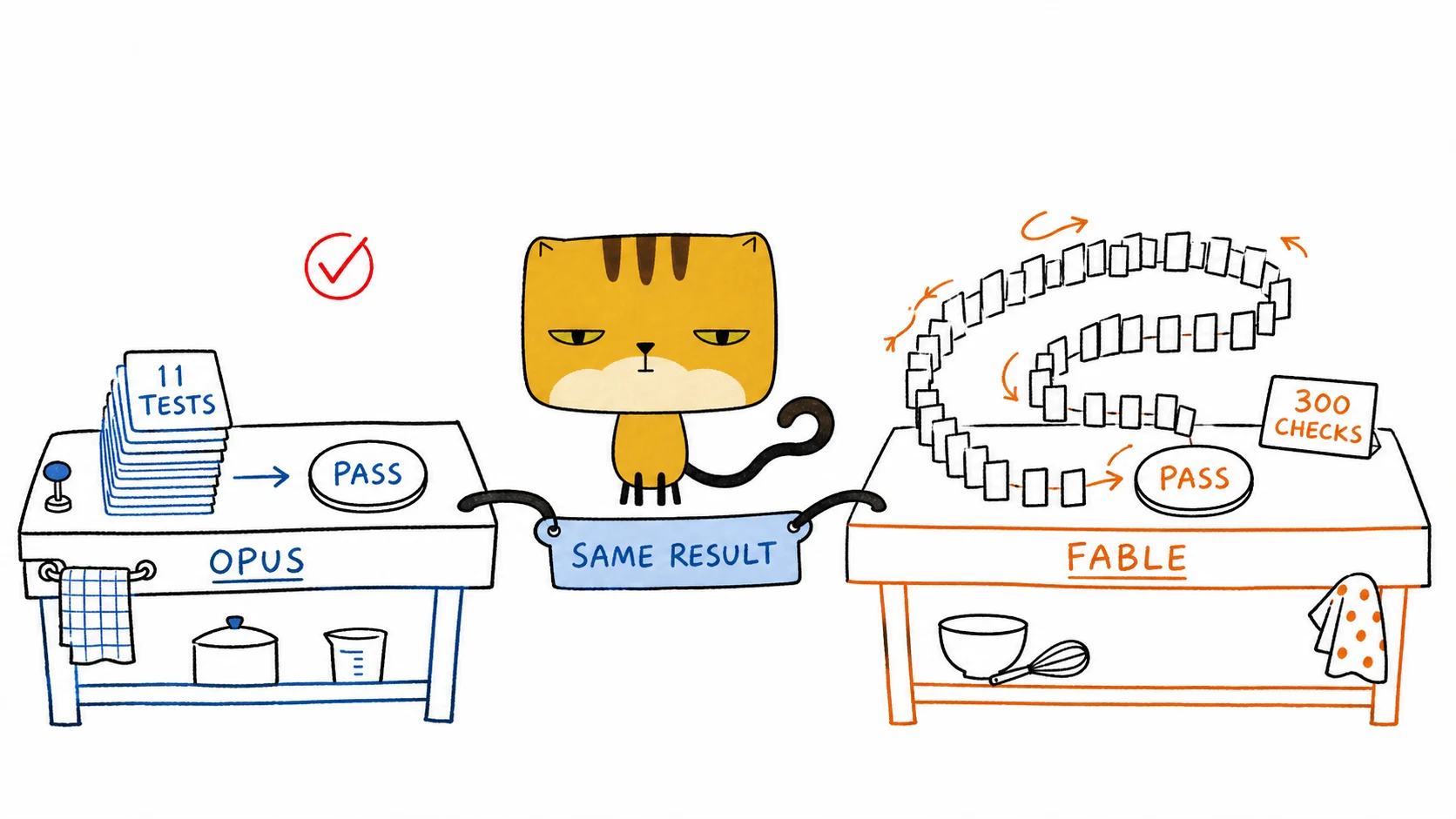
Both implementations passed every hidden algorithm test, but their self-checking looked nothing alike. Fable 5 generated 300 randomized comparisons against a reference implementation. Opus 5 wrote 11 test cases by hand.
Both also produced a perfect ETL result: ten merged orders and an exact revenue total. Opus 5 used 11 tool calls, while Fable 5 used nine. In this run, Fable validated more aggressively while making slightly fewer calls.
The subjective task created the only real gap
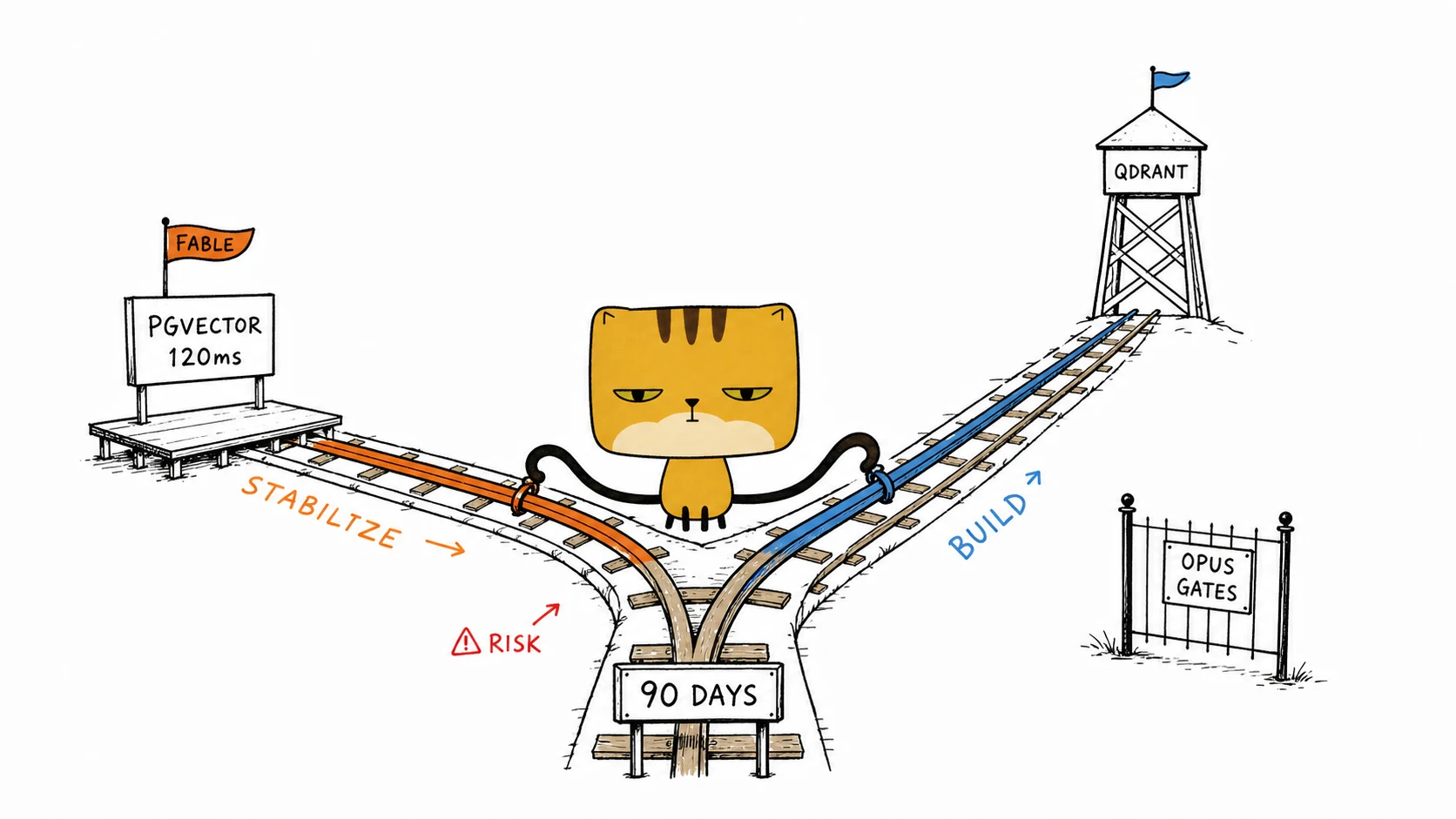
The decision memo presented a familiar architecture choice: bring pgvector’s p95 latency down from 180 ms to below 100 ms while a set of 20 million vectors triples over the next year. The model had to recommend one of three options to a CTO: optimize pgvector deeply, run a self-hosted vector database, or use a managed service.
Both chose self-hosted Qdrant and produced well-structured memos. The difference was strategy. Fable 5 proposed two tracks: spend 30 days stabilizing pgvector with halfvec quantization and ef_search tuning to reach roughly 120 ms, buying time while building the Qdrant end state in parallel. Its closing idea was simple: use option A to buy time and option B to build the destination. Opus 5 offered a careful migration path with decision gates, but did not address the transition period as directly.
The blind review had a wrinkle. The Opus judge ran twice and produced two scorecards with different margins: 9.5 to 8.5, then 8.5 to 8.25. I used its final run in the aggregate.
Across those two scorecards and the Sonnet judge’s review, with the A/B order reversed, all three ranked Fable’s memo first for the same reason: the two-track plan was closer to engineering reality. The ranking stayed the same, but the changing margin is a reminder that model judges have variance of their own.
Neither model consistently obeyed “answer only”
Several tests asked for only the answer. Opus 5 added a prohibited preface or reasoning in three tasks, while Fable 5 did it in two. There is a confounder here: the subagent framework itself required agents to return a result summary, which may have encouraged extra text. I treat this observation as directional only.
My takeaway
In this test, the models were almost indistinguishable. Their objective scores matched, their total runtimes were close, and the only gap came from a subjective memo where Fable 5 edged ahead.
I would choose by task, not by the overall total.
For the math, logic, coding, extraction, and ETL work covered here, Opus 5 delivered the same result at half the price and also offered Fast Mode. It is the better value.
Fable 5 did better on open-ended judgment. Its “stabilize first, then build the end state” memo also fits its stronger showing on public long-horizon autonomy benchmarks. The tradeoffs still matter: it comes with a 30-day data-retention requirement and a more sensitive safety classifier.
This was a tiny sample with one run per task. I will need at least n=5 before saying anything useful about variance.